
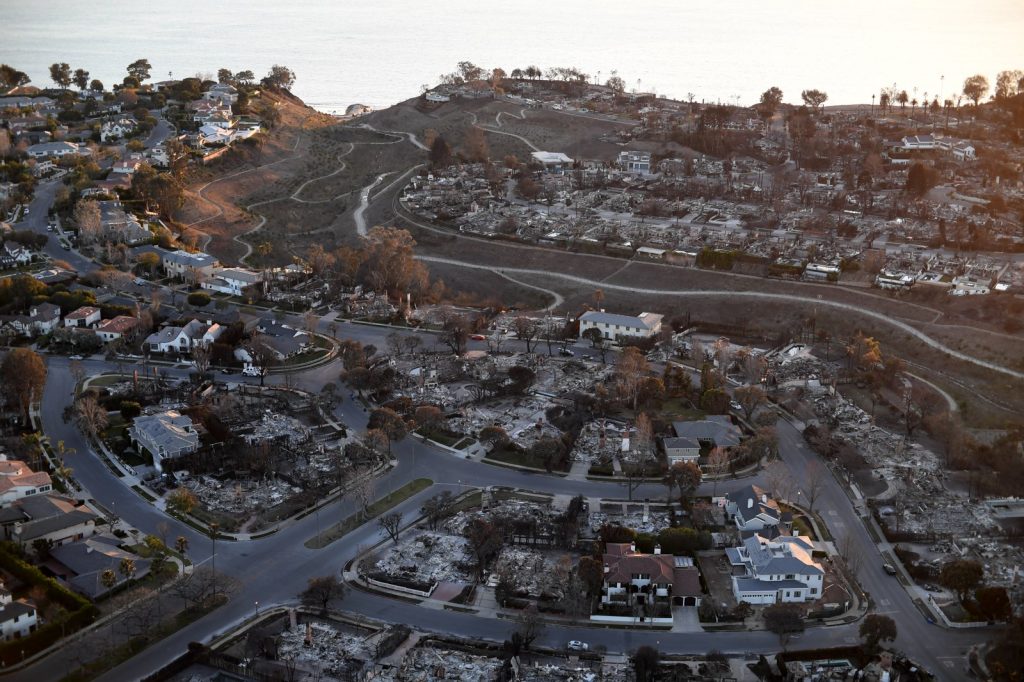
A jury couldn’t agree. That’s the blunt fact at the center of the Palisades Fire case. After deliberations that stretched long enough to signal trouble, the judge declared a mistrial.
The suspect, who remains in custody, now waits for a second trial. The first one ended in deadlock.
Legal observers are parsing what that deadlock means. Their focus isn’t just on the defendant. It’s on the jury itself.
The question being asked in court hallways and analyst notes: did ideology hang the jury? The Palisades Fire case has always carried a secondary narrative.
The suspect allegedly fixated on Luigi Mangione. Mangione faces separate charges in a case that has drawn national headlines. Court filings and testimony have traced that fixation, though the precise nature of the connection remains a matter of record, not public certainty.
What is clear is that the two cases are now linked in the public and legal consciousness. The mistrial injects fresh uncertainty into that landscape. Prosecutors must now recalculate their approach.
A retrial means a new jury. A new jury means a new chance for deadlock.
The fear, as some observers have put it, is that ideology is creeping into the jury box. And if it crept into this box, what stops it from creeping into the next one? That question lands hardest on the Mangione case.
Mangione’s own trial looms. The legal environment has just shifted.
Defense attorneys and prosecutors alike are recalibrating. If a jury could not reach a unanimous verdict on the Palisades Fire suspect, what does that portend for a case that has already commanded more attention? The calculus is cold: a hung jury in a lower-profile case does not bode well for a higher-profile one.
The broader stakes extend beyond any single defendant. Legal analysts are watching to see whether the deadlock reflects a deeper trend. The creeping influence of political or ideological leanings among jurors.
This is not a new concern. But it is a sharpening one.
High-profile cases have always drawn scrutiny. What is different now is the suspicion that jurors are bringing more than their life experience into the deliberation room. They are bringing their allegiances.
The Palisades Fire suspect remains in custody. The underlying charges have not been resolved.
The mistrial declaration does not clear anyone. It resets the clock. It gives prosecutors a second chance.
It gives the defense a second chance to argue the same case to a different audience. It gives everyone more time to watch and wait. What this signals, strategically, is a recalculation.
Prosecutors face a decision: try the case the same way, or change tack. The defense faces the same choice.
Both sides now know that a jury can hang. That knowledge changes how you negotiate. It changes how you argue.
It changes how you pick a jury in the first place. The Mangione case will be selected from the same pool of citizens.
The same potential for ideological bias exists. The same fear exists. The mistrial in the Palisades Fire case is not a verdict.
It is a warning shot. And the next trial will be the test of whether anyone heard it.




