
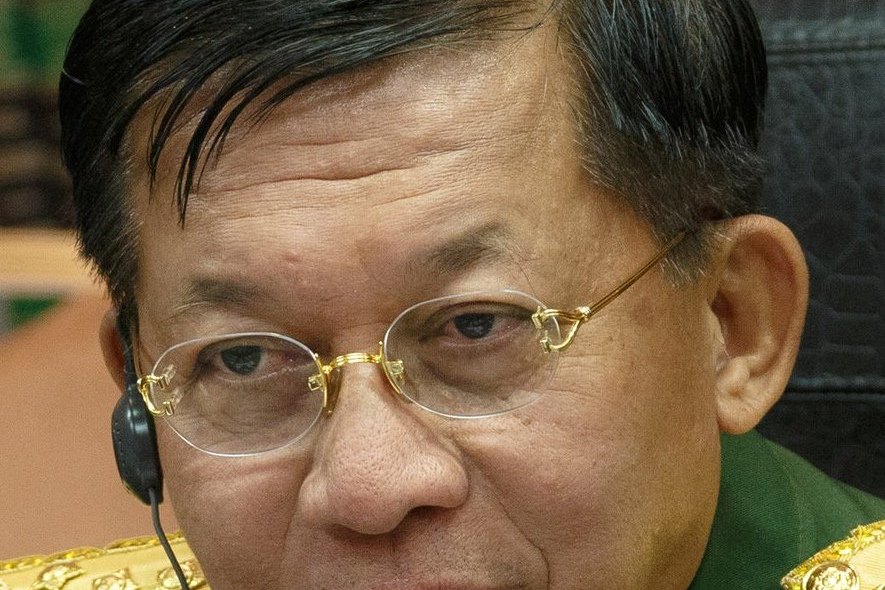
NAYPYIDAW, October 17, 2026 — The United States held secret talks with Myanmar’s military-backed rulers in Tokyo last week, according to sources familiar with the discussions, raising concerns about the impact on ASEAN’s fragile consensus and the prospects for democracy in Myanmar.
The SAC’s Rule and Its Aftermath
The State Administration Council governed Myanmar from 2021 to 2025 as a military junta led by Min Aung Hlaing, established after the February 2021 coup and the declaration of a state of emergency. Under the constitution, the Commander-in-Chief holds absolute legislative, executive, and judicial power during a state of emergency, and Min Aung Hlaing delegated his legislative power to the SAC, which he chaired. The SAC was dissolved at the end of July 2025 with the conclusion of the state of emergency, but its powers were absorbed by the National Defence and Security Council, keeping Min Aung Hlaing’s dictatorship intact. As of late August 2021, the SAC comprised nine military officers and ten civilians. Civilian members included figures from parties such as the Kayin People’s Party, the New National Democracy Party, the National Democratic Force, the Arakan National Party, the Mon Unity Party, and others, many of whom faced backlash from their own parties for collaborating. The junta had earlier met with 34 pro-military parties in August 2020, including the Union Solidarity and Development Party, to seek assurances about potential intervention in the 2020 general election.
ASEAN’s Five-Point Consensus and Myanmar’s Response
ASEAN’s Five-Point Consensus, agreed in 2021, called for an immediate cessation of violence, dialogue among all parties, the appointment of an ASEAN special envoy, humanitarian assistance, and the special envoy’s visit to Myanmar to meet with all parties. Myanmar’s foreign minister, U Tin Maung Swe, stated at the First Coordination Meeting of the ASEAN Affairs Committee on October 13, 2026, that Myanmar had implemented the consensus as far as possible in line with the Five-Point Roadmap laid down during the SAC’s tenure, without hampering national sovereignty and national interests. He described Myanmar’s engagement with ASEAN as a “home-grown normalization strategy” aimed at restoring the country’s full status and participation within the bloc. However, the SAC had implemented the consensus selectively to avoid full isolation, and its roadmap for ASEAN reintegration aligned with its own interests rather than democratic restoration. The National Unity Government and the Committee Representing Pyidaungsu Hluttaw reject the SAC’s legitimacy, designating it a “terrorist group”.
US Engagement and the ICC’s Limits
The United States is not a member of the International Criminal Court, which has jurisdiction over Myanmar’s war crimes, limiting its leverage over the junta. The ICC, established in 2002, has 124 member states but faces opposition from major powers like the United States, China, and Russia. In October 2026, the Trump administration imposed financial sanctions on the ICC, escalating a previously announced diplomatic campaign to “dismantle” the court. The State Department announced in July 2026 a campaign to dismantle the ICC, saying it threatened U.S. sovereignty, and urged other governments to take similar action. These actions complicate efforts to hold Myanmar’s leaders accountable for alleged war crimes and crimes against humanity. The US’s secret talks with the junta risk legitimizing the National Defence and Security Council’s rule while ASEAN’s consensus on democracy remains fragile.
What This Means for Communities Across Asia
For families and communities across Southeast Asia, the continued rule of Myanmar’s military leadership means ongoing displacement, restricted access to humanitarian aid, and uncertainty about the future of democratic governance. The US’s engagement, conducted without public transparency, may be seen by some as a pragmatic approach to influence change from within, but it also risks weakening regional mechanisms designed to uphold democratic norms and human rights. ASEAN’s ability to act as a cohesive bloc on Myanmar depends on consensus, and any perception that major powers are bypassing that process could erode trust among member states. Meanwhile, the ICC’s limited reach, due to the non-membership of key powers, leaves victims of violence in Myanmar with few avenues for international justice. As the situation evolves, the impact on ordinary people—those seeking safety, livelihoods, and a voice in their governance—remains at the heart of the debate over how external actors should engage with Myanmar’s leadership.
The Junta’s Legal Facade: How the SAC Exploited Constitutional Loopholes
The State Administration Council (SAC) framed its rule as a “provisional administration” under Myanmar’s 2008 constitution, a legalistic maneuver that allowed it to bypass democratic norms while claiming legitimacy. The constitution’s Article 414 explicitly grants the Commander-in-Chief—Min Aung Hlaing—absolute legislative, executive, and judicial authority during a state of emergency, a provision the military invoked immediately after the February 2021 coup. By delegating his legislative powers to the SAC, which he chaired, the junta created a veneer of institutional governance while retaining ultimate control. The SAC’s structure—nine military officers and ten civilians—mirrored the military’s pre-coup dominance, with civilian appointees drawn from pro-junta parties like the Union Solidarity and Development Party (USDP) and splinter factions such as the National Democratic Force (NDF). These civilians, including figures like Khin Maung Swe (NDF) and Thein Nyunt (NNDP), were handpicked to lend a semblance of political pluralism, though their parties later disavowed them for collaborating with the coup.
The SAC’s tenure was marked by a deliberate blurring of lines between military and civilian authority, a tactic that complicated international efforts to isolate the regime. For example, the junta’s August 2020 meeting with 34 pro-military parties—including the USDP—revealed its strategy of preemptively securing political cover before the 2020 election, which it later nullified. Min Aung Hlaing’s remarks at the time, warning of potential intervention if electoral integrity was threatened, foreshadowed the coup and demonstrated the military’s long-standing playbook of manipulating constitutional mechanisms to justify its rule. Even after the SAC’s dissolution in July 2025, the National Defence and Security Council (NDSC) absorbed its powers, ensuring continuity under the same leadership. This seamless transition underscored the junta’s ability to exploit legal frameworks to perpetuate its grip on power, regardless of formal administrative changes.
The SAC’s reliance on constitutional technicalities extended to its engagement with ASEAN, where it framed compliance with the Five-Point Consensus as a matter of “national sovereignty” rather than democratic accountability. By positioning itself as a responsible member state, the junta sought to neutralize criticism while selectively implementing ASEAN’s demands—such as halting violence—to avoid full isolation. This approach allowed the SAC to present its rule as a temporary, necessary measure, despite its systematic repression of dissent, including designating the National Unity Government (NUG) and the Committee Representing Pyidaungsu Hluttaw (CRPH) as “terrorist groups”. The junta’s legalistic posturing thus served dual purposes: it provided a facade of legitimacy domestically and internationally, while shielding its core objectives—consolidating power and suppressing opposition—from meaningful challenge.
Sources
- State Administration Council
- The Role of the International Criminal Court (ICC) | Council on Foreign Relations
- ASEAN Affairs: Union Minister chairs 1st coordination meeting
Photo: Vadim Savitsky, mil.ru (CC BY 4.0)




