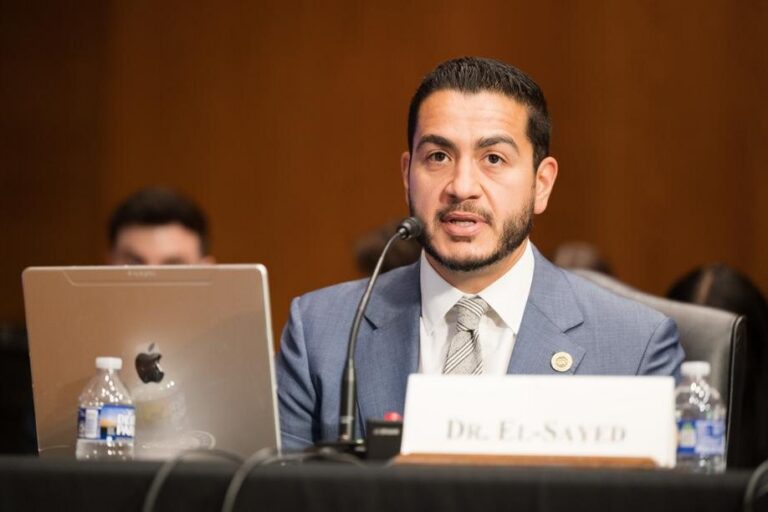
Republican presidential nominee Donald Trump escalated his rhetoric against Democratic Senate candidate Abdul El-Sayed this week, attempting to undermine the Michigan politician by tying him to Islamic extremism. At a town hall in Caro, Michigan, an audience member asked El-Sayed if he would disavow the Muslim Brotherhood. El-Sayed responded that he is “running for Senate and happens to be Muslim,” turning the question back on the asker. Republicans, including Trump and his Senate surrogate Mike Rogers, have spent weeks trying to associate the Egyptian-American candidate with the transnational Islamist organization, a tactic that echoes post-9/11 scrutiny faced by Muslim candidates across the United States.
From Detroit Health Commissioner to Senate Contender
Abdul El-Sayed was born on October 31, 1984, in Rochester Hills, Michigan, to Egyptian immigrant parents. His father, Mohamed El-Sayed, arrived in the United States to pursue graduate studies at Wayne State University, while his mother, Fatten El-Komy, worked as a nurse practitioner. El-Sayed was raised in the Detroit area and graduated from Bloomfield Hills Andover High School in 2003, where he distinguished himself as a three-sport athlete. He went on to attend the University of Michigan, earning a bachelor’s degree in biology and political science in 2007. While a student, he led a medical mission to Peru and founded a student organization supporting a local free clinic.
El-Sayed’s academic path took him to the University of Oxford as a Rhodes Scholar, where he earned a doctorate in public health. He later received his medical degree from Columbia University and joined the faculty at the Columbia University Mailman School of Public Health as an assistant professor of epidemiology. His career in public health administration began in Detroit, where he served as executive director of the Detroit Health Department from 2015 to 2017. From 2023 to 2025, he led the Wayne County Department of Health, Human & Veterans Services. These roles positioned him as a hands-on administrator during critical moments in Michigan’s public health landscape.
Progressive Platform and Primary Victory
El-Sayed entered the 2026 Senate race as a progressive Democrat. His platform includes support for Medicare for All, ending U.S. military funding to Israel, and abolishing ICE. He entered the Democratic primary against U.S. Representative Haley Stevens, defeating her to secure the party’s nomination. If elected, El-Sayed would make history as the first Muslim member of the U.S. Senate. His candidacy has drawn attention not only for his policy positions but also for his identity as a Muslim-American from the Midwest.
Attacks and the ‘Disavow’ Controversy
The general election campaign has been marked by sharp exchanges between El-Sayed and Republican nominee Mike Rogers. At their second and final debate in Detroit, Rogers repeatedly claimed El-Sayed has a “pattern of deception” regarding his record and personal history. El-Sayed dismissed the Republican attacks as “MAGA Bingo” and suggested a vote for Rogers is a vote for the Trump administration’s policies. The debate, hosted by WXYZ Detroit, also featured sharp disagreements on trade, Social Security, and immigration.
Perhaps the most sustained line of attack has come from Republicans seeking to link El-Sayed to Islamic extremism. Throughout the Senate campaign, including from former President Donald Trump and Rogers, El-Sayed has been asked to disavow the Muslim Brotherhood. The question, posed at a public event, invoked the organization as a proxy for asking Muslim candidates about their views on terrorism. El-Sayed’s terse response — that he is “running for Senate and happens to be Muslim” — highlighted the friction between his identity and the campaign’s tactics. Political analysts noted that the request reflects a broader pattern of asking Muslim officeholders to account for the actions of others, a dynamic religion scholars have described as presuming collective guilt by association.
National Support and Final Stretch
El-Sayed’s Senate bid has attracted high-profile surrogates. Former President Barack Obama is scheduled to headline a rally in Detroit in support of the Democratic nominee. The race against Rogers is seen as a competitive contest in a key swing state, with both candidates trading accusations of obfuscation and extremism. As Election Day approaches, El-Sayed’s campaign has focused on his record in public health administration and his progressive policy platform, while navigating a barrage of rhetoric linking his faith to political attacks.
Campaign Trail Surrogates and Rally Appearances
The general election campaign for Michigan’s Senate seat has featured prominent national figures rallying behind the candidates. According to Bridge Michigan, former President Barack Obama is scheduled to headline a rally in Detroit in support of Democratic nominee Abdul El-Sayed. In a statement following the second general election debate, El-Sayed expressed enthusiasm about Obama’s appearance, telling reporters that having the former president on the campaign trail is “a good thing.” On the Republican side, former President Donald Trump is headlining a rally in St. Clair County, near Canada, with Republican nominee Mike Rogers indicating he would attend. Rogers noted that his relationship with Trump makes him uniquely positioned to push back on certain policies, stating that President Trump “is going to be here two years, like it or not,” and that he has already stood up to the president on issues he considers important. The presence of these high-profile surrogates has supercharged a race already focused on competing economic plans and contrasting visions for the state’s future. El-Sayed’s campaign has leaned into the endorsement, framing Obama’s support as validation of his progressive platform, while Rogers has attempted to leverage the former president’s popularity to bolster his own general election bid. This dynamic has transformed the final weeks of the campaign into a high-profile referendum on both the candidates and the national figures backing them.
Beyond the presidential surrogates, the campaign has seen active participation from sitting officials and local leaders. Bridge Michigan reports that El-Sayed will join Obama in Detroit for the rally, marking a significant moment for the Democratic nominee as he campaigns in a key swing state. The race has been described as competitive, with both candidates trading accusations of obfuscation and extremism throughout the final stretch. As Election Day approaches, El-Sayed’s campaign has focused on highlighting his record in public health administration and his progressive policy platform, specifically Medicare for All and ending U.S. military funding to Israel, while navigating a barrage of rhetoric linking his faith to political attacks. The strategic use of national surrogates underscores the race’s importance as a battleground contest, with both sides leveraging high-profile endorsements to energize their base and persuade undecided voters in the closing days of the 2026 election cycle.
Sources
- Abdul El-Sayed
- Fact check: Abdul El-Sayed, Mike Rogers debate trade, money, immigration, more – Bridge Michigan
- What Republicans mean when they ask Abdul El-Sayed to ‘disavow’ the Muslim Brotherhood | CNN
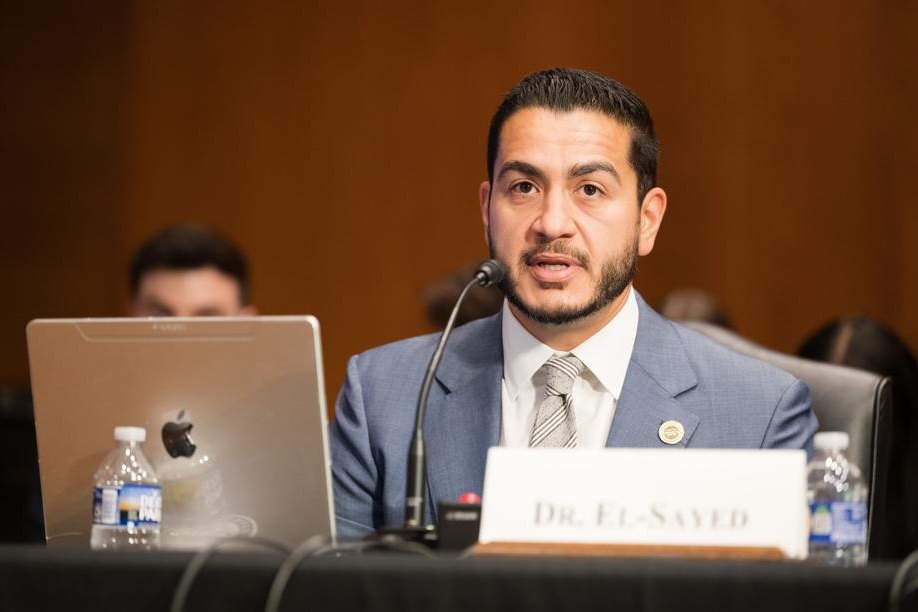
Photo: U.S. Senate Committee on Health, Education, Labor and Pensions (Public domain)