
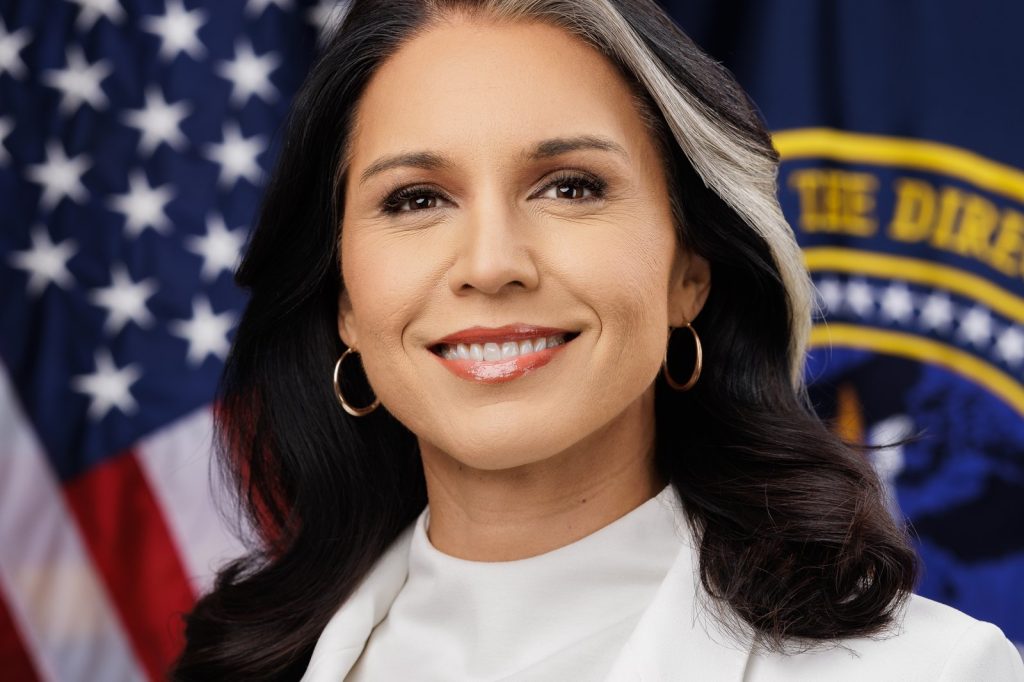
Director of National Intelligence Tulsi Gabbard has made the declassification of past election-security intelligence a central focus of her tenure since assuming office in 2025. That effort moved a significant step forward this month when a team she created inside the Office of the Director of National Intelligence referred evidence about China’s role in the 2020 election to the Intelligence Community Inspector General. The referral transforms a long-running public dispute about whether intelligence findings were suppressed into a formal internal review process.
Formal Review Underway
In 2026, Gabbard’s office established the Director’s Initiative Group, or DIG, a unit tasked with examining how the intelligence community assessed foreign activity around the 2020 election. According to reporting, the DIG submitted to Inspector General Christopher Fox a body of evidence suggesting that China’s role in 2020 was de-emphasized or omitted from final analytic products.
A referral to the Inspector General is a formal request for an independent internal review; it represents an allegation to be examined, not a finding of wrongdoing. The distinction matters because the U.S. system routes such concerns through the Inspector General and analytic-integrity channels so that they are examined on the record rather than through public speculation. The DIG’s action puts the question of whether the intelligence community handled China assessments properly under official scrutiny.
The documentary record already in public view underpins the allegation. Then-DNI John Ratcliffe, in a January 2021 letter, argued that China and Russia were assessed under different standards.
Separately, the ODNI Analytic Ombudsman report by Barry Zulauf found analysts hesitant to characterize Chinese actions as interference. Those findings contrast with the majority judgment of the 2021 Intelligence Community Assessment, which was delivered on January 7, 2021, and declassified on March 16, 2021, at dni.gov. That assessment concluded that China did not deploy interference efforts to change the 2020 outcome. The charge that this finding was suppressed is the position held by Gabbard, Ratcliffe, and the ombudsman’s findings.
Whether the evidence supports that charge is precisely what an Inspector General review will determine.
Contested Assessments and Their Backdrop
The competing views reflect a fundamental disagreement within the intelligence community about the standards applied to Chinese and Russian activities. Ratcliffe’s January 2021 letter argued that the two countries were judged under different criteria, a contention that the Ombudsman report partially supported by noting analysts’ reluctance to label Chinese actions as interference.
The 2021 ICA, which represents the coordinated judgment of all 18 intelligence agencies, affirmed that China did not seek to alter the outcome of the 2020 election. The dispute is not about whether China acted, but about whether those actions met the threshold of interference and whether that threshold was applied consistently. The Inspector General’s independent review will examine the evidence the DIG has referred and determine whether any analytic standards were violated or information improperly omitted.
Further declassification of election-security intelligence remains pending. Gabbard has made such declassification a signature effort since becoming DNI, and the referral to the Inspector General is part of a broader push to bring more transparency to how the intelligence community assessed foreign election interference in 2020.
The process ensures that allegations are investigated through established channels rather than through competing public narratives.
Geopolitical Context
The review unfolds against the backdrop of China’s global stature. China is a country in East Asia with a history stretching back to the Paleolithic era, evolving through dynastic rule, imperial unification, and modern political transformation.
After centuries of imperial governance, the 1911 Revolution ended monarchical rule, leading to the Republic of China, civil war, and eventually the 1949 establishment of the People’s Republic of China under the Chinese Communist Party. The PRC emerged as a socialist state and later adopted market reforms, becoming a major global economic and military power. China is a unitary one-party state governed by the Communist Party, a permanent member of the United Nations Security Council, and a leading manufacturer with substantial influence in global trade, technology, and geopolitics.
Its size, history, and economic weight give its actions outsized importance on the world stage, including in matters of election integrity and international relations. That context underscores why the intelligence community’s assessment of Chinese activities around the 2020 election carries consequences not only for domestic trust but also for U.S. relations with Beijing and for the broader framework of how foreign interference is defined and countered.
The referral to Inspector General Fox sets in motion a process that is designed to be both independent and on the record. Whether the evidence supports the allegation that China’s role was de-emphasized or omitted will be determined by that review. In the meantime, Gabbard has signaled that further declassification of election-security intelligence will continue, keeping the focus on transparency as the review proceeds.




