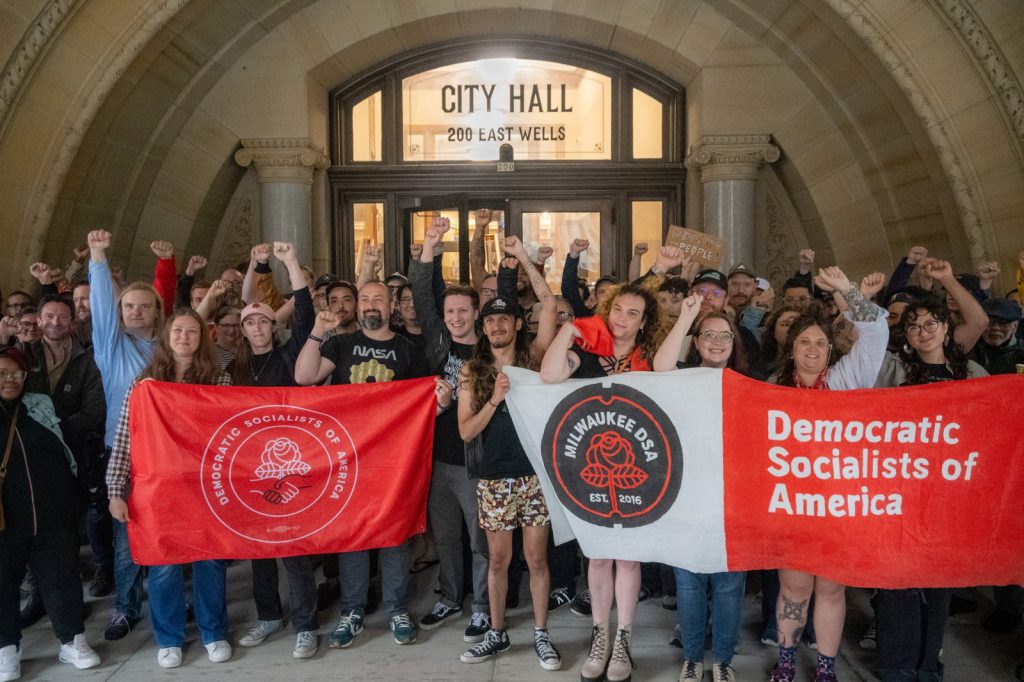
As dusk settles over America’s major blue cities, the hum of daily life gives way to something more charged. In public squares, parks, and community centers, residents are gathering not for entertainment but for debate.
The topic: whether socialist policies belong in the nation’s economic and political future. The atmosphere, by all accounts, is one of fervent activism—a sharp rise in interest in socialist ideology has been noted in recent months, with many citing the appeal of principles such as equality and fairness. Individuals from all walks of life come together to share their perspectives, and by nightfall the streets echo with passionate arguments and heated discussions.
The air, residents say, feels electric with a sense of movement gaining momentum, drawing ever more people into a conversation about the country’s direction. New York stands as a primary stage, but the phenomenon spans across America’s big, blue cities.
Those on the ground describe a sense of uncertainty as this wave continues to crash against the shores of traditional politics. City residents are at the forefront, many taking to social media and other platforms to express their views and connect with likeminded people. Observers say it will be important to watch how city leaders respond to the growing demand for socialist policies and reforms.
As the night wears on, discussions only grow more intense, participants delving deeper into the nuances of socialist theory and its potential applications in modern America. It is clear that this conversation will continue to evolve and shape local politics in the days and weeks to come.
The Historical Awakening Behind Today’s Debates
The ideas now animating street-corner arguments did not emerge overnight. Democratic socialism as a distinct political tradition first took shape in the 19th century as a response to the inequalities wrought by industrial capitalism.
Early movements—the Chartists in Britain, socialist parties in Germany and France—argued for public ownership of key industries and for workplace democracy. By the late 1800s, gradualist approaches had begun to reshape socialist thought away from revolution and toward reform. The Fabian Society in Britain and the German theorist Eduard Bernstein, for instance, advocated incremental change within democratic systems.
The term “democratic socialism” gained a clearer definition in the mid-20th century, partly as an effort to separate itself from the authoritarian Soviet-style socialism that had come to dominate global perceptions. Rather than one-party rule and centralized planning, democratic socialism emphasizes multi-party democracy and decentralized economic power.
At its core, it pairs democratic governance with social ownership of major industries, aiming to reduce economic inequality while preserving political freedoms. Its intellectual roots run through figures such as Rosa Luxemburg, who warned against bureaucratic socialism, and later thinkers who distanced themselves from Cold War-era state socialism. Instead, the tradition advocates worker cooperatives, public utilities, and mixed economies guided by democratic decisions.
Shaping the Nation’s Political Future
Today, those historical currents have found renewed expression in urban politics across the United States. Local leaders and activists are pushing for policies such as universal healthcare, affordable housing, and labor protections—all under the banner of democratic socialism.
The movement’s appeal often grows during periods of economic strain, when voters question whether traditional capitalism delivers shared prosperity. Critics argue that such policies risk inefficiency or high costs, but supporters see them as a return to economic fairness. The US administration, led by President Donald Trump, Vice President JD Vance, and Secretary of State Marco Rubio, is navigating the complexities of this shift.
How the situation will unfold remains to be seen. What is certain is that the future of American politics will be shaped, in part, by the conversations and debates taking place in these cities.
For observers, the debate reflects broader questions about the role of government in shaping economic outcomes—and whether democratic socialism offers a sustainable alternative to both unfettered markets and authoritarian socialism. As one resident put it, the night’s arguments are not just about policy; they are about the very direction of the nation. Looking ahead, it will be crucial to monitor developments in America’s big blue cities as this wave continues to push against the shoreline of long-held political norms.